
After click "Buy Now", the item are placed in PRIVATE WAREHOUSE.

|
|
Discontinued
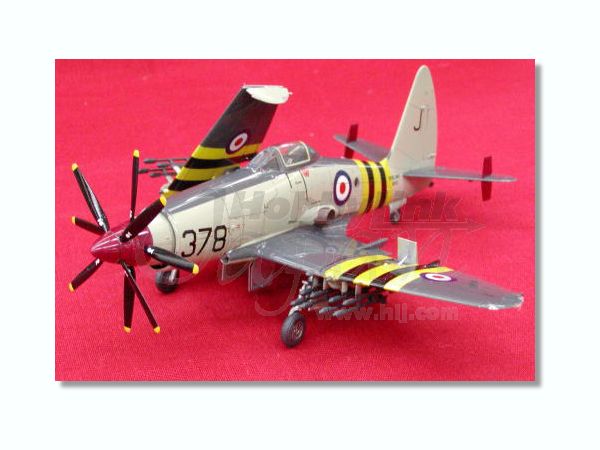
1/72 RN Westland Wyvern S.4
by Trumpeter
$17.92 USD
$22.41 USD
This item is discontinued and is not expected to come back into stock.
Description
This is an injection-plastic aircraft model kit.
Finally! A newly-tooled injection-plastic Wyvern kit! We've only waited, what, 40-odd years? Three thousand yen may seem like quite a bit for an injection plastic airplane kit of this size, but let us assure you that you get more than your money's worth!
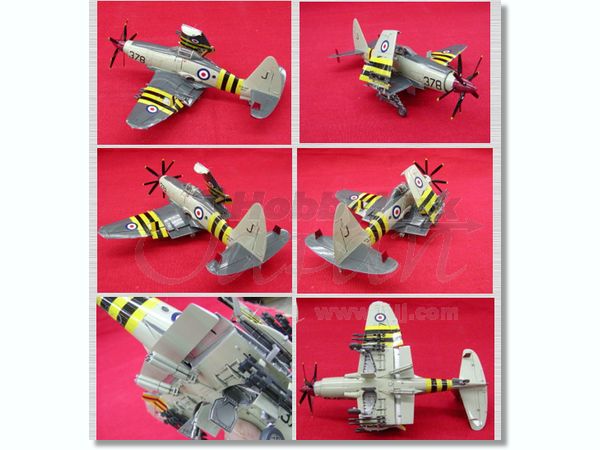
Start in the cockpit: the ejection seat alone is made of 9 pieces. Add to this miniature kit in itself, a complete cockpit tub with full console and sidewall detail; the rudder pedal adjustment knob is even included as a separate part! The propellers have complete hub detail inside the spinner, and the front and rear props are separate assemblies so you can turn them independently of one other. The wings build up in sections so you can pose them folded or extended, as you wish. The flaps are designed to be assembled extended; however, with just a little trimming you should be able to build them retracted if you so desire (certainly better than having them molded up and then trying to drop them!). Pay particular attention when you're building the wings, too -- there are a lot of armament options from which to choose, and depending which option(s) you choose, you will need to open up certain holes in the lower center wing section. The landing gear is also nicely detailed, right down to having the "Dunlop" markings molded on the tire sidewalls. The outer wing panels have separate airbrakes that can be attached either opened or closed. The wingtip sections have clear parts attached for the navigation lights; once this is done you can assemble the wing as you wish.
And of course, let's not forget the aforementioned armament options! In the box you get an 18" MK.15/17 torpedo for the centerline, three 1000 lb. MC bombs, eight twin-launcher rocket racks (for a total of sixteen 60 lb. rockets), and two underwing 90 gal. drop tanks. Also, the large RATO racks used by the Wyvern to help get these beasts off the carrier deck are included.
Finally we come to the decal options, and here you get three airplanes from which to choose: WP337, tail code J, a/c number 378 of 830 Sq. aboard the HMS Eagle during Operation Musketeer (the Suez Conflict) in 1956; WL765 "Dennis the Menace," tail code E, a/c number 270 of 813 Sq. aboard the HMS Eagle in 1958; and WP335, tail code O, a/c number 388 of 831 Sq. aboard the HMS Ark Royal in 1957. This last aircraft carries a small gnome (troll?) painted on the starboard nose. The decals for the aircraft from 830 Sq. include full Suez stripes in yellow and black.
As far as we can see, there are only two things that could be done to improve this kit: belts for the ejection seat, and deeper exhausts for the engines. The first problem can be solved with any of the various photo-etched seatbelts available on the market, or with strips of lead foil; while the exhausts can be improved with drilling and filling, or replacements made from brass tube. But these are minor issues, easily addressed, and in no way detract from what is an outstanding kit of one of the great failures of Royal Naval Aviation.
Details
- Code: TRPMCT006
- JAN Code: 4523231870007
- Release Date: 2005/04/18
- Category: Aircraft
- Country of Origin: Japan
- Series: 1/72 Aircraft
- Item Type: Military Propeller Kits
- Manufacturer: Trumpeter
- Item Size/Weight: 38 x 24 x 5 cm / 370g
- Storage Fee per Month: ¥369 (¥335 base + 10% consumption tax)
Assembly Guide






All contents © 2024 HobbyLink Japan Ltd. Kurohakama-cho 162-1, Sano, Tochigi 327-0813 JAPAN